Mathematics at Ryedene
“We are Mathematicians”
Subject Leader: Ms Grange
My name is Ms Grange and I am the Subject Leader for Maths across our school. I have a love for Maths and problem-solving and how these skills are woven into our everyday lives without us even realising it. This has made me determined that all of the children at Ryedene will leave our school with the best Maths skills that are possible for each individual child, to try to support them in their next educational journey as well as their adult lives. During my time as a teacher, I have witnessed the successes and stresses that can be encountered by children in Maths and, as a consequence, have worked with the teaching staff and support staff to find ways to overcome the stresses and to celebrate the successes so that every child is proud of their achievements in Maths. You cannot escape Maths, no matter how hard you might try, so it is my aim to ensure that children are always willing to have a go, to embrace making mistakes and to see Maths as something to enjoy.
Vision: The vision for Mathematics at Ryedene is to deliver a high-quality mathematics education that provides a foundation for understanding the world, the ability to reason mathematically, an appreciation of the beauty and power of mathematics, and a sense of enjoyment and curiosity about the subject. At Ryedene, the teaching of Maths aims to enable each child to develop their learning and achieve their full potential. We endeavour to not only develop the mathematics skills and understanding required for later life, but also to foster an enthusiasm and fascination about Maths itself. We aim to increase pupil confidence in Maths so that they are able to express themselves and their ideas using the language of Maths. As children become fluent in the language of mathematics and become increasingly able to reason and explain their thinking mathematically, they become increasingly able to solve problems in a range of contexts, noting connections between areas of maths and proving their answers by using a wide range of mathematical thinking. We want the children to see mathematics as being relevant to their world and applicable to everyday life as well as being something that they will need as they move on through their school life and ultimately to the world of employment.
What we are teaching in Maths: Maths are Ryedene will be taught daily. The teaching of Maths is inclusive and will include provision for Maths for all pupils on the school roll. The content of Maths taught will allow our aims of creating mathematicians to be met through having significant coverage of the skills and knowledge guided by the National Curriculum. Consequently, we will endeavour to ensure the children become fluent in the fundamentals of mathematics, including through varied and frequent practice with increasingly complex problems over time, so that pupils develop conceptual understanding and the ability to recall and apply knowledge rapidly and accurately, reason mathematically by following a line of enquiry, conjecturing relationships and generalisations, and developing an argument, justification or proof using mathematical language, can solve problems by applying their mathematics to a variety of routine and nonroutine problems with increasing sophistication, including breaking down problems into a series of simpler steps and persevering in seeking solutions. Distinct domains are taught but are also interconnected:
- Number – including place value, addition, subtraction, multiplication, division, fractions, decimals and percentages
- Measurement
- Geometry – including properties of shape, position and direction
- Statistics (from Year 2)
- Ration and Proportion (Year 6)
- Algebra (Year 6)
Children need to be regularly exposed to increasingly complex problems to solve, which allow them to apply their maths knowledge. In doing so, they are encouraged to develop an argument and line of enquiry which they can prove and justify using mathematical vocabulary.
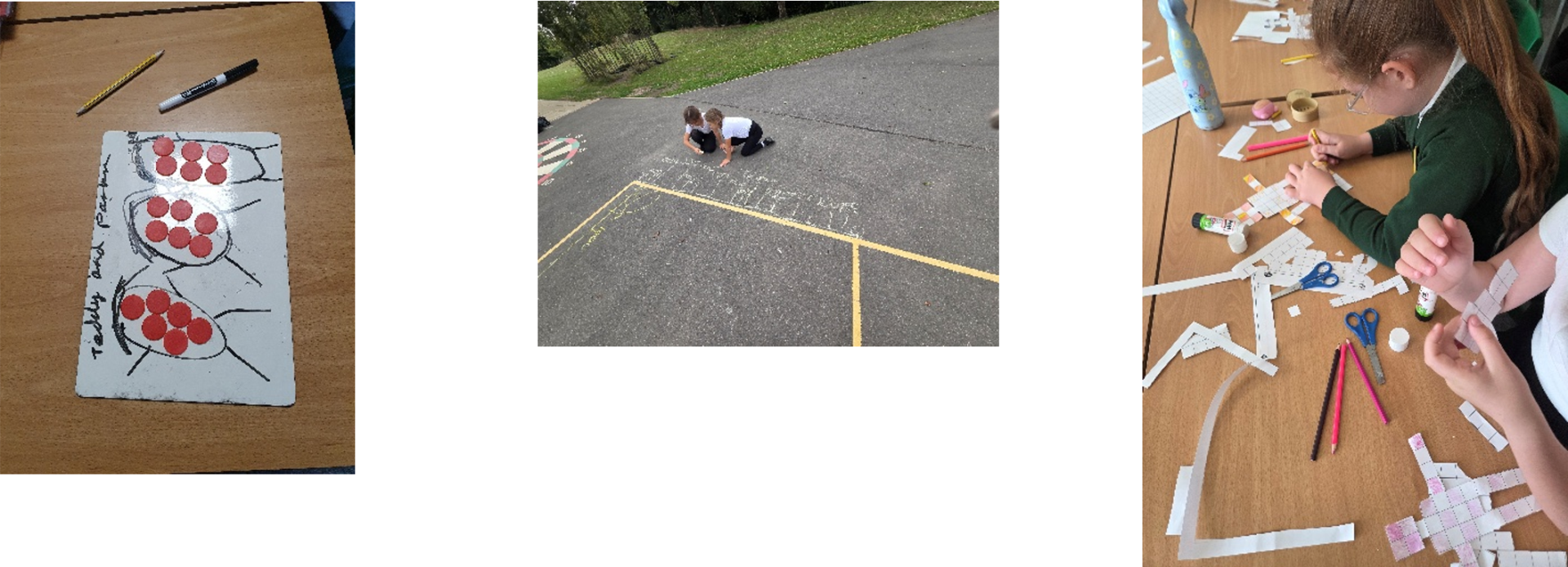
How we teach Maths: At Ryedene, we have smaller ability sets from Year 1, and teachers use the White Rose Scheme of Work as guidance to plan their sequences of lessons, this is used alongside the National Curriculum, to ensure that there is full coverage of the curriculum. A Mastery approach is adopted which ensures that the majority of children are studying at broadly the same place. However, decisions about when to progress is based on the security of pupils’ understanding and their readiness to progress to the next stage. Pupils who grasp concepts rapidly are challenged through being offered rich and sophisticated problems before any acceleration through new content. Those who are not sufficiently fluent with earlier material consolidate their understanding, including through additional practice, before moving on. Alongside the Mastery approach, we also encourage the use of a ‘CPA’ approach (Concrete, Pictorial, Abstract) Teachers have a Calculation Policy and progression of skills documents to support their planning and teaching. Planning has the required models and examples to support learning outcomes as well as key questions to ensure skills are revisited and remembered, thus building on prior knowledge.
At Ryedene Primary and Nursery School we teach Maths in a way that:
- creates a lively, exciting and stimulating environment in which the children can learn Maths
- promotes the concept that acquiring maths knowledge and skills provides the foundation for understanding the world around the children
- develops mental strategies
- encourages children to use mathematical vocabulary to reason and explain
- allows time for partner talk in order to stimulate and develop a curiosity for Maths
- challenges children to stretch themselves and take risks in their learning
- creates a sense of awe and wonder surrounding Maths
- ensures children in Key Stage 1 are secure in their understanding of number and number relationships
- delivers Maths in line with National Curriculum guidelines.
To enable us to deliver this, we use a range of resources that will stimulate and challenge children of all abilities.
Impact – what the children have learnt: Children at Ryedene enjoy having an engaging Maths curriculum which promotes cross-curricular links as well as links with their daily lives. Through engaging in Maths lessons, all children can develop their confidence and self-esteem, as well as developing life skills, whilst at Ryedene. The main focus for each key stage is as follows:
Key Stage 1 - ensure that pupils develop confidence and mental fluency with whole numbers, counting and place value; develop their ability to recognise, describe, draw, compare and sort different shapes and use the related vocabulary and be able to use a range of measures to describe and compare different quantities such as length, mass, capacity/volume, time and money. By the end of year 2, pupils should know the number bonds to 20 and be precise in using and understanding place value. Pupils should read and spell mathematical vocabulary, at a level consistent with their increasing word reading and spelling knowledge at Key Stage 1.
Lower Key Stage 2 - to ensure that pupils become increasingly fluent with whole numbers and the four operations, including number facts and the concept of place value, leading to efficient written and mental methods being used and calculating accurately with increasingly large whole numbers; develop their ability to solve a range of problems, including with simple fractions and decimal place value; draw with increasing accuracy and develop mathematical reasoning so they can analyse shapes and their properties, and confidently describe the relationships between them and use measuring instruments with accuracy and make connections between measure and number. By the end of year 4, pupils should have memorised their multiplication tables up to and including the 12 times multiplication table and show precision and fluency in their work. Pupils should read and spell mathematical vocabulary correctly and confidently, using their growing word reading knowledge and their knowledge of spelling.
Upper Key Stage 2 - to ensure that pupils extend their understanding of the number system and place value to include larger integers, developing the connections between multiplication and division with fractions, decimals, percentages and ratio; develop their ability to solve a wider range of problems, including increasingly complex properties of numbers and arithmetic, and problems demanding efficient written and mental methods of calculation; use algebra as a means for solving a variety of problems; geometry and measures consolidates and extends knowledge developed in number and shapes are classified using increasingly complex geometric properties. By the end of year 6, pupils should be fluent in written methods for all four operations, including long multiplication and division, and in working with fractions, decimals and percentages. Pupils should read, spell and pronounce mathematical vocabulary correctly.
Evidence to support this is gathered through formal assessments, book looks, pupil perceptions and observations.